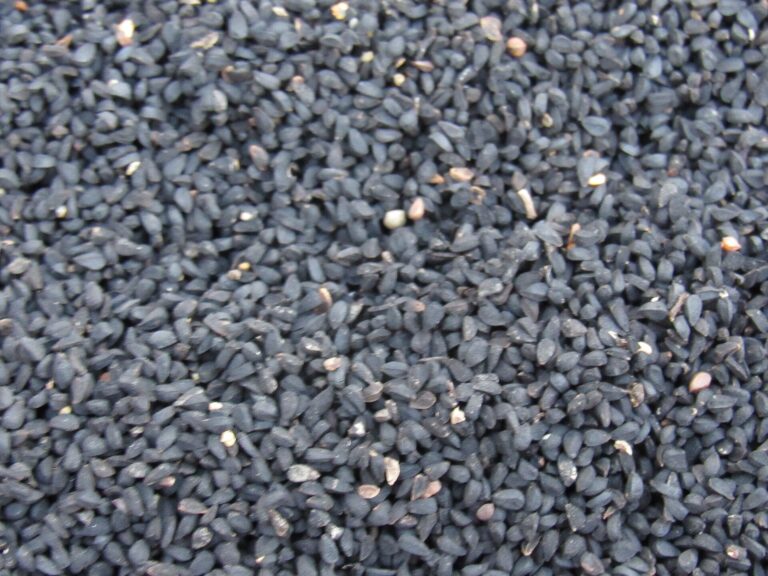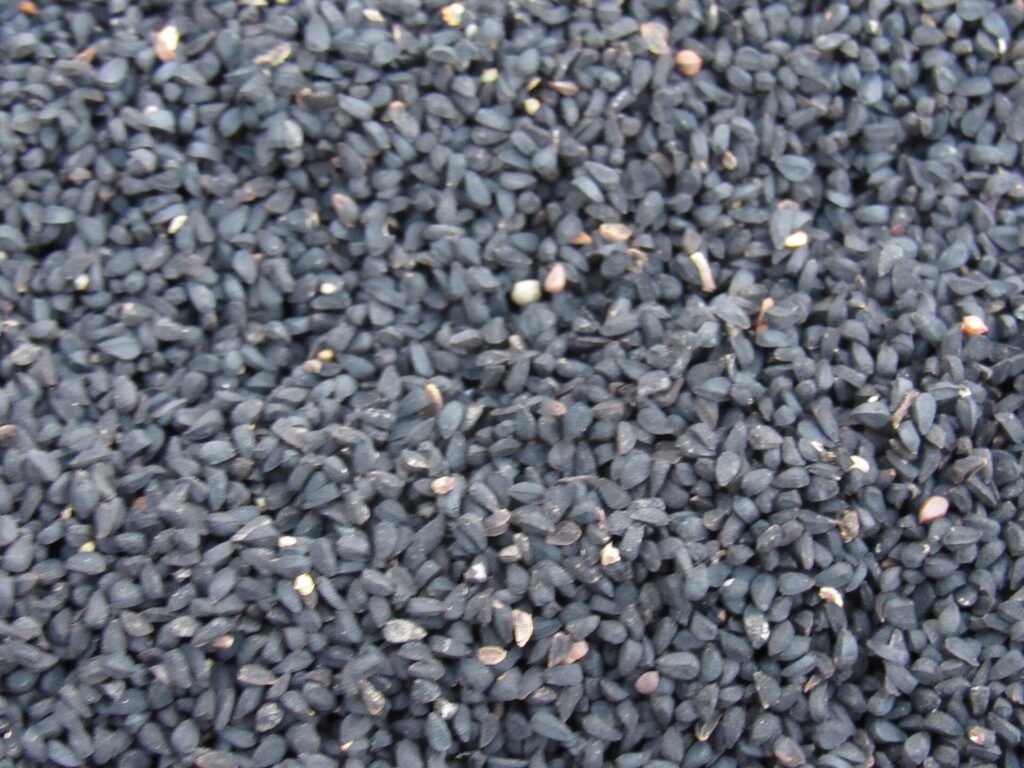
Black seed

Nigella sativa · Buttercup family (Ranunculaceae)

Hi, I'm Black Seed! I'm tiny and black, and I love sitting on warm bread.

Black seed
Image: Afifa Afrin · CC BY-SA 4.0 · Wikimedia Commons

What does it help with?

  • Blood sugar

    In grown-ups, black seed lowered blood sugar Sugar from food that travels in your blood to give your body energy. a little in studies. Better studies are still needed.

    🟡 Scientists think so

  • Heart & blood vessels

    Black seed may lower blood pressure a little in grown-ups.

    🟡 Scientists think so

  • Mum's milk supply

    In some countries, mums eat black seed to make more milk. Science has not proven this.

    🔵 Grandma's wisdom

What do the colored dots mean?
  • 🟢 Scientists are sure Strong evidence (several good human trials)
  • 🟡 Scientists think so Some evidence (small human studies)
  • 🟠 Still being studied Early evidence (lab or animal studies only)
  • 🔵 Grandma's wisdom Traditional use (not scientifically confirmed)

How we grade evidence

Careful if…

For kids OK in normal food Pills, powders & oils: ask a grown-up first

A sprinkle of black seed on bread is fine for kids. Black seed oil capsules are for grown-ups, with a doctor's OK.

  • Diabetes medicines

    👀 Be careful

    People taking diabetes medicine should ask their doctor before black seed oil or pills.

  • Blood-pressure problems or medicines

    👀 Be careful

    People taking blood-pressure medicine should ask their doctor first.

  • Breastfeeding

    👀 Be careful

    Mums who breastfeed should ask a doctor before black seed supplements.

  • Allergies

    👀 Be careful

    Black seed oil on the skin can cause an itchy rash in some people.

If you have too much…

  • An itchy rash where the oil was put.

Natural does not always mean safe. Always ask a grown-up before trying something new, and a doctor or pharmacist before taking any supplement. Try the safety check →

What is it?

Black seed comes from a small plant with pale blue or white flowers. After the flowers, it makes round pods full of tiny black seeds.

The seeds taste a little like onion and pepper. In Morocco they are called sanouj. People sprinkle them on bread and use their oil.

How people use it

In the kitchen

  • Sprinkled on bread, msemmen and cheese.
  • Mixed into pickles and spice blends.

Traditional uses

🔵 Grandma's wisdom — not proven by science

  • Used for a very long time in the Middle East and North Africa as a home remedy for many things.

On skin & body

  • The oil is rubbed on skin and hair.

Fun facts

  1. It is sometimes called black cumin, but it is not related to cumin at all!

  2. Its seeds were found in the tomb of the Egyptian king Tutankhamun.

  3. The plant is a cousin of buttercups.

Grow it yourself

  • Easy
  • Lots of sun
  • A little water
  • Grows in a pot
  • About 3 to 4 months
  1. Sow a few seeds in a pot of light soil and cover them a little.
  2. Keep the pot in the sun. Water when the soil is dry.
  3. Enjoy the pretty flowers!
  4. When the pods turn brown and dry, shake out the black seeds.

Quiz time!

Answer 3 questions. Get 2 right to win this plant’s badge for your garden!

  1. What is black seed called in Morocco?

  2. Is black seed a kind of cumin?

  3. Where do the black seeds grow on the plant?

Your plant card

Print it, cut it out and collect them all!

Black seed

Nigella sativa

Superpowers
Blood sugar Heart & blood vessels Mum's milk supply
Careful
Diabetes medicines, Blood-pressure problems or medicines
Growing
⭐

🤩 It is sometimes called black cumin, but it is not related to cumin at all!

supplementsmorocco.com

For grown-ups: science, amounts & safety

Tap to open

General information, not medical advice. Talk to a doctor or pharmacist before using any herbal supplement — especially during pregnancy or breastfeeding, for children, before surgery, or if you take medicines. Medical disclaimer

What the research says

Use Evidence Details
Blood sugar 🟡 Some evidence (small human studies) A 2019 meta-analysis of clinical trials found black seed lowered fasting and after-meal glucose and HbA1c, with oil more effective than powder[2]. An overview of 20 meta-analyses judged most of this evidence to be of low or very low quality[1].
Heart & blood vessels 🟡 Some evidence (small human studies) A 2023 meta-analysis of randomised trials found black seed supplements lowered systolic blood pressure by about 3 mmHg and diastolic by about 2.7 mmHg, with high variation between studies[3].
Mum's milk supply 🔵 Traditional use (not scientifically confirmed) Black seed is used as a galactagogue in India, Türkiye and the Middle East, but no scientifically valid clinical trials support this use[4].

Who should be careful & interactions

  • 👀 Be careful Diabetes medicines: Because black seed may lower glucose[2], people on glucose-lowering medicines should monitor their blood sugar.
  • 👀 Be careful Blood-pressure problems or medicines: Black seed may lower blood pressure[3]; combined with antihypertensive medicines, blood pressure should be monitored.
  • 👀 Be careful Breastfeeding: No data exist on the passage of black seed into breast milk or its safety in infants, although limited information suggests it is generally well tolerated[4].
  • 👀 Be careful Allergies: Black seed oil can cause allergic contact dermatitis[4].

Possible side effects

  • Mild Allergic contact dermatitis from topical oil[4].

Names & identifiers

Scientific name
Nigella sativa
Also called
Nigella, Black cumin, Kalonji
Wikidata
Q160575

Sources

  1. Nigella sativa and health outcomes: An overview of systematic reviews and meta-analyses Frontiers in Nutrition · 2023 · Research review · PubMed
  2. Effect of Nigella sativa (black seed) supplementation on glycemic control: A systematic review and meta-analysis of clinical trials Phytotherapy Research · 2019 · Research review · PubMed
  3. Antihypertensive effects of Nigella sativa supplementation: An updated systematic review and meta-analysis of randomized controlled trials Phytotherapy Research · 2023 · Research review · PubMed
  4. Black Seed – Drugs and Lactation Database (LactMed) National Library of Medicine (NIH) · Database

✅ Reviewed by sm_owner on September 26, 2026.

Last updated September 25, 2026. How we write and check our pages

✏️ Suggest an edit

We only use this to improve the page. We never share it.